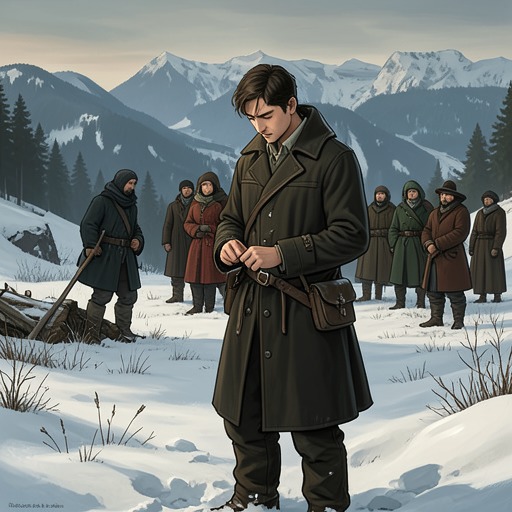
Voostenwalbert Schimmelpenninck
Hans Brinker, or The Silver SkatesVoostenwalbert Schimmelpenninck, usually called Voost or Master Voost, is a young boy in the circle of Dutch skaters. His appearances are brief, but they make him more than a name in the crowd: he is a quick interjector, an eager spectator of conflict, and a volunteer whose companions still treat him as a little child. The difference between his own readiness and their estimate of him supplies the comic tension in his part of the story.
Identity and Introduction
Voost first speaks up during the excited discussion of the silver skates offered as the prize for the skating match on the twentieth, held on Madame van Gleck’s birthday. While the other children embellish their guesses about the prize, he interrupts to challenge the claim that the skates have bells. Rychie Korbes answers that Voost himself had said they did; the group immediately divides into competing assertions about what the prize looks like. His small voice does not settle the question, but it establishes his place in the company: he is willing to enter a noisy conversation and be held accountable for what he has said.
The episode also gives him a characteristic comic scale. The prize is being imagined as magnificent, complete with straps, buckles, and perhaps bells, while Voost’s contribution is a small, pointed correction. His full name, unusually long among the boys, becomes part of the joke later when Carl Schummel insults him. Yet Voost is not merely a target of teasing: he speaks up, follows the conversation closely, and enjoys being able to contribute knowledge when a stranger arrives.
A Spectator of Conflict
When Carl objects to the prospect of admitting two poor skaters to the group, Peter van Holp deliberately misreads his meaning and challenges the exclusion. Carl turns on Peter, warning him not to put words in other people’s mouths. Voost laughs, delighted by the prospect of a fight and confident that Peter, his favorite, could beat a dozen excitable fellows like Carl. His response places him not among the disputants but among the audience, where he treats the quarrel as entertainment and imagines its likely outcome as a contest of strength.
Peter’s look makes Carl turn away from the stronger opponent and lash out at Voost instead, calling him a weasel, a skinny herring, and a monkey with a long name. The sudden redirection exposes the risk in Voost’s amusement: the fight he welcomes as spectacle brings the hostility close enough to make him its object. The narrator does not describe a reply from Voost, so the scene shows his delight and Carl’s attack, but not how he responds to the insult.
Eagerness to Join In
Voost is also a source of information when Jacob Poot approaches with his English cousin, Benjamin Dobbs. Before Jacob introduces Benjamin, Voost tells the other boys that Benjamin is Jacob’s cousin, that he will stay with Jacob until after the grand race, and that he has a funny little name. Jacob then confirms the introduction and says Benjamin will take part in the race. Voost’s pleasure at being able to supply the news briefly makes him the group’s announcer; his interest in the newcomer is tied to the gathering’s shared excitement about skating and the contest.
When Jacob explains the plan for the journey, the boys eagerly volunteer to go. Voost ventures that he will go too, but Jacob mocks him as too small, asking whether he has even stopped wearing his protective head pads. The narrator clarifies that children in Holland wore a padded cushion, with a whalebone-and-ribbon framework, to guard against falls; giving it up marked the passage from babyhood to childhood. Voost had left his pads behind several years earlier, so Jacob’s taunt is unfair by the standard the story itself supplies. The narrator adds that the insult is too much for him to endure. His willingness to volunteer therefore meets a humiliating reminder that the older boys still see him through the image of a much younger child.
Absence and Narrative Role
At the early start, the group checks that Ludwig van Holp is present and calls for Voost by his full name. There is no answer. The boys conclude that the little rogue has been kept at home, then set off at eight o’clock in fine weather, expecting to reach Amsterdam in thirty minutes across the firm IJ. Voost does not join this departure, despite having offered to accompany the earlier plan. The passage supplies no further explanation of his absence, so it does not establish whether he was prevented from going or simply failed to appear.
Across these moments, Voost is defined less by a sustained personal arc than by the contrast between lively intention and limited standing among his companions. He corrects the group over the bells, relishes Peter’s imagined victory, shares news about Benjamin, and volunteers for a journey; at the same time, Carl’s insult and Jacob’s joke reduce him to a small body with a long name. His brief appearances give the ensemble scenes a shifting social texture: he can interrupt, inform, and eagerly join, but he cannot control how the older boys receive him.